
Description
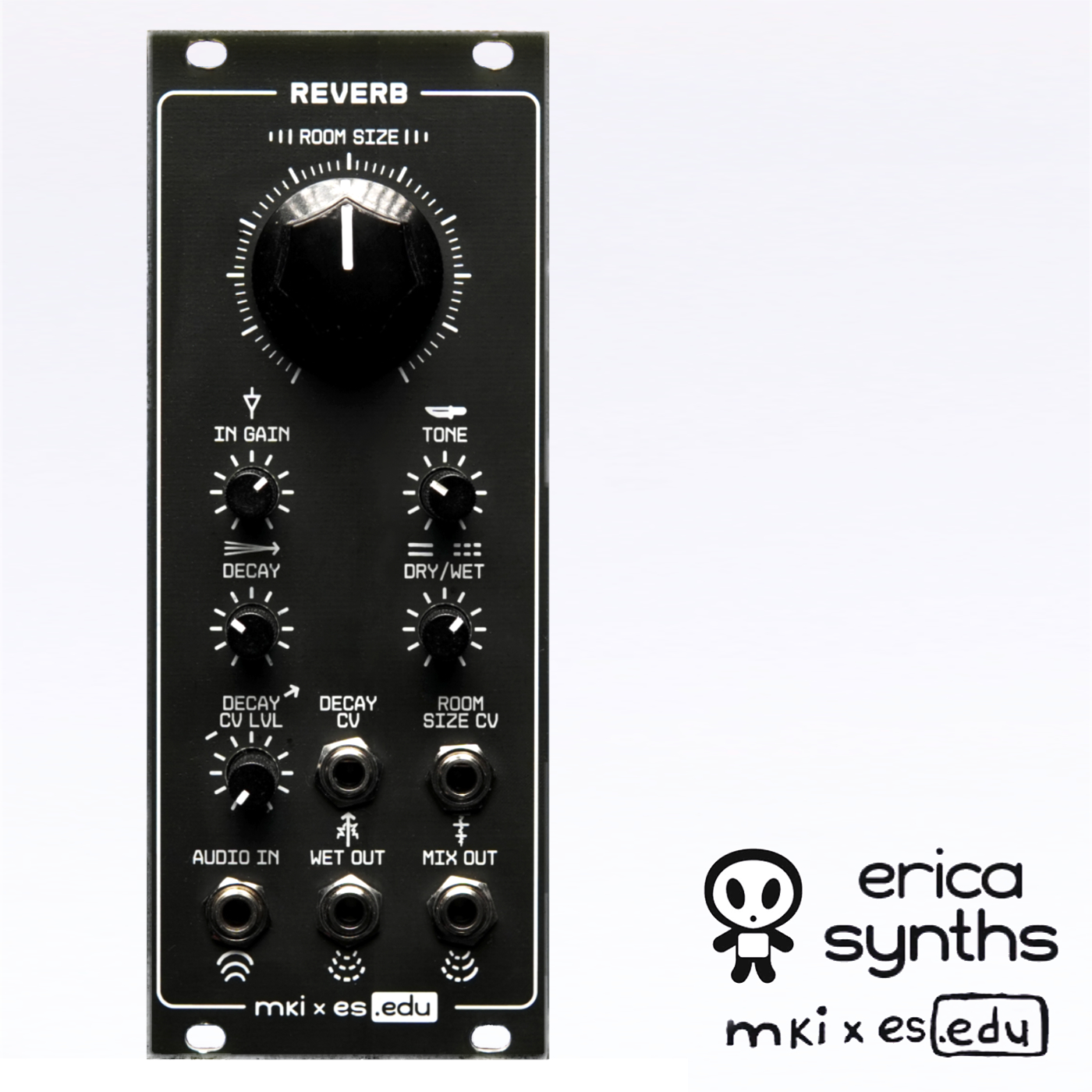
This educational DIY kit lets you build and understand a fully analog reverb without springs, plates or code. On a breadboard, you’ll learn how to turn two BBD chips into a simulated room, then add controls for tone, decay and room size.
The manual uses clear diagrams and analogies to explain every step. Afterwards, you’ll assemble the kit into a 10HP Eurorack module using the included PCBs and panel. It has the same footprint as the EDU DIY BBD module, so KONSTRUKT-8 owners can easily swap between BBD & Reverb in the system case.
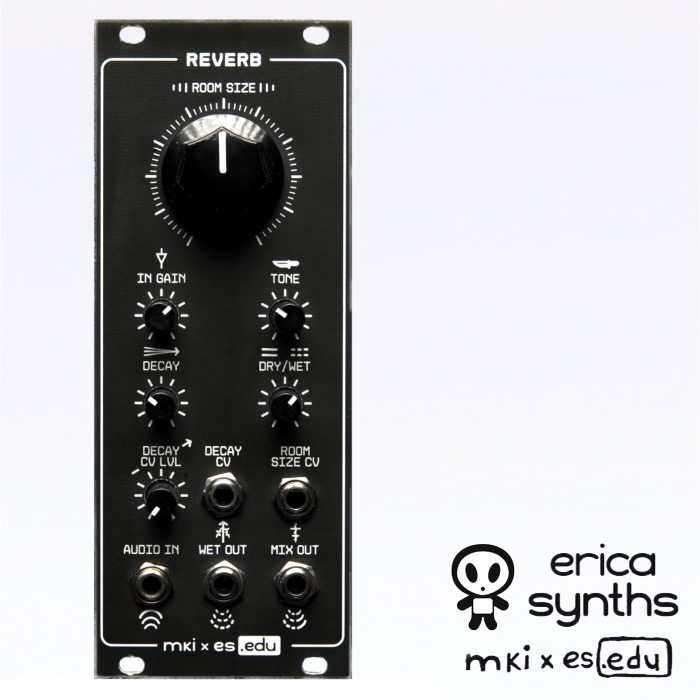
Once assembled, you’ll end up with a Eurorack Reverb module with:
- Room size control (from large hall to impossibly small spaces)
- Input gain control
- Tone control (from concrete to foam walls)
- Decay control (from short ambience all the way up to self-oscillation)
- Dry/wet control
- Decay CV input with level control
- Room size CV input
- Wet output (independent of the dry/wet control)
- Mix output
What you’ll learn
BBD Delay Design:
- Input scaling and biasing
- Dual clock generation
- Output reconstruction and clock spike filtering
- Feedback echo chains
Analog Reverb Architecture:
- Time-axis echo scattering with golden-ratio delay times
- Setting up a simple feedback delay network (FDN)
- Going from metallic resonator to reverb
- Tone shaping with a tilt filter
Voltage Control:
- Using transistor VCAs for variable decay
- Hacking BBD clock driver chips for variable room size
- Keeping the two clocks locked at a fixed ratio
What’s included
- All components for the breadboard & module build
- Eurorack panel + PCBs for final assembly
- Power cable
- 55+ page illustrated PDF manual (digital download)
Reverb – Build Document
Skill level: Proficient. Soldering difficulty is on par with the Erica EDU Hi-Hat and Drum Sequencer kits. Calibration requires an oscilloscope or multimeter that can measure oscillation frequency (LABOR Scope doesn’t support this yet).
If you want to prototype the circuit on a breadboard then you’ll also need: a breadboard, jumpers, a ±12V supply with an additional 5V rail, a multimeter, and an oscilloscope or multimeter that can measure oscillation frequency.
Want a smoother start? LABOR is a purpose-built prototyping platform for Erica Synths educational DIY kits. It replaces the breadboard, jumpers and power supply with a single intuitive workspace designed specifically for learning analog circuit design. The manual’s breadboard layouts are built around it.
About the series
This kit is part of our mki x es.EDU lineup, a collaboration between Erica Synths and Moritz Klein to make analog circuit design accessible, hands-on and genuinely educational.
NB: This kit is designed as a self-guided learning tool. While we don’t offer individual support for failed builds, the manual includes a detailed troubleshooting section with test points to help you diagnose and fix issues yourself – a crucial part of the learning experience.