Description
View this post on Instagram
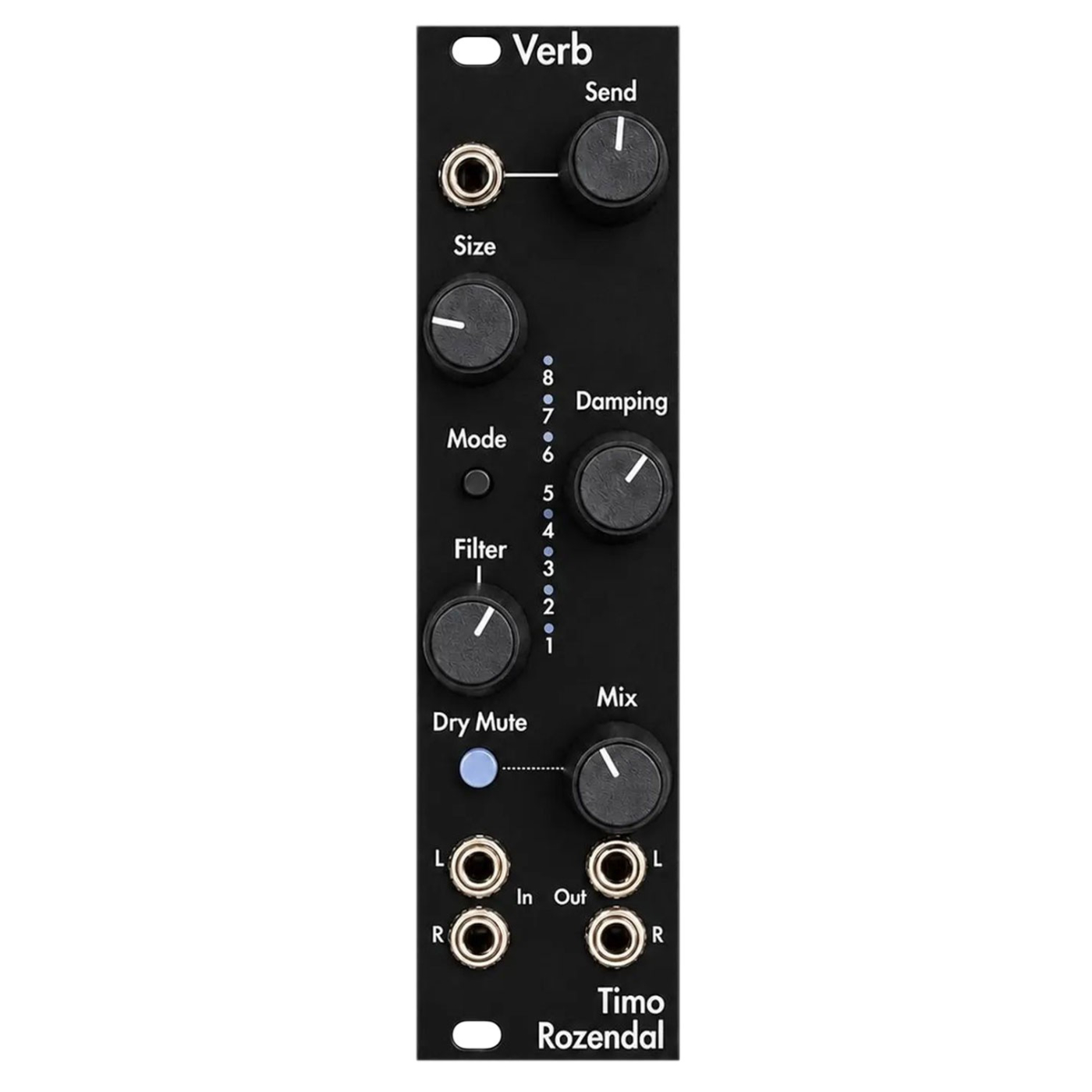
VERB is a stereo reverb module for Eurorack with eight distinct reverb modes.
Each mode is a different reverb topology rather than a different preset on one engine — the networks themselves are built differently, so a mode change rebuilds the entire reverb rather than re-tuning it. That is why switching modes takes about half a second and fades rather than cuts.
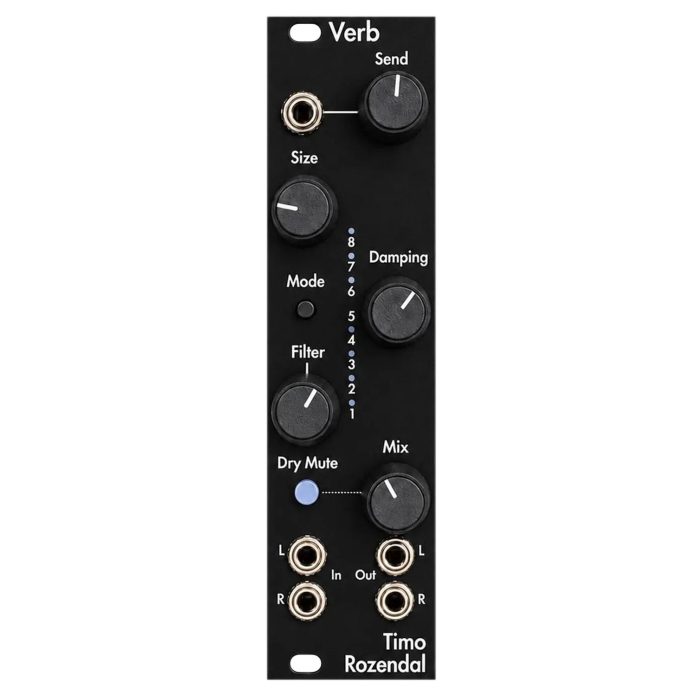
The controls are designed to optimize sweet spots and keep the reverb in useful territory: Send decides how hard the reverb is driven, Size sets the space, Damp sets how fast the high end dies away, Filter shapes the tail with a single bipolar tilt, and Mix blends against the dry input. Everything else — diffusion, modulation rate and depth, stereo width, tail wobble — is fixed per mode, chosen by ear for that mode.
The eight modes run from the smallest space to the largest, in panel order. Modes 1 and 2 are small rooms, 3 to 5 are chambers and rooms, 6 and 7 are halls, and 8 is a long plate. They are level-matched to each other, so cycling through them does not jump in volume.
VERB works on everything, but the small modes reward percussive and close material and the large modes reward sustained sources.
Verb – Build Document | User Manual
Features
- Eight mode stereo reverb
- Each reverb mode uses a unique algorithm
- Send sets the amount of drive applied to the reverb algorithms, and affects the how the reverbs react to incoming audio
- Size sets the length of the reverb
- Damping places a low pass filter in the feedback path, causing the high end to decay over time
- Filter adds a tilt filter to make the output brighter or darker
- Mix between your incoming audio and the reverb output
- Dry Mute turns off the incoming audio but does not affect the reverb’s output
- CV over Send amount
- Toggling modes rebuilds each algorithm in real time, fading out from one and into another over half a second
- All modes level matched to prevent sudden jumps in volume
Specs
- Width: 6HP
- Depth: 30mm
- Current draw: 30mA @ +12V, 10mA @ -12V
- Audio: stereo in, stereo out (IN L is normalled to IN R)
- CV: one ±5 V input, added to Send
- Converter: 24-bit; DSP runs at 48 kHz